
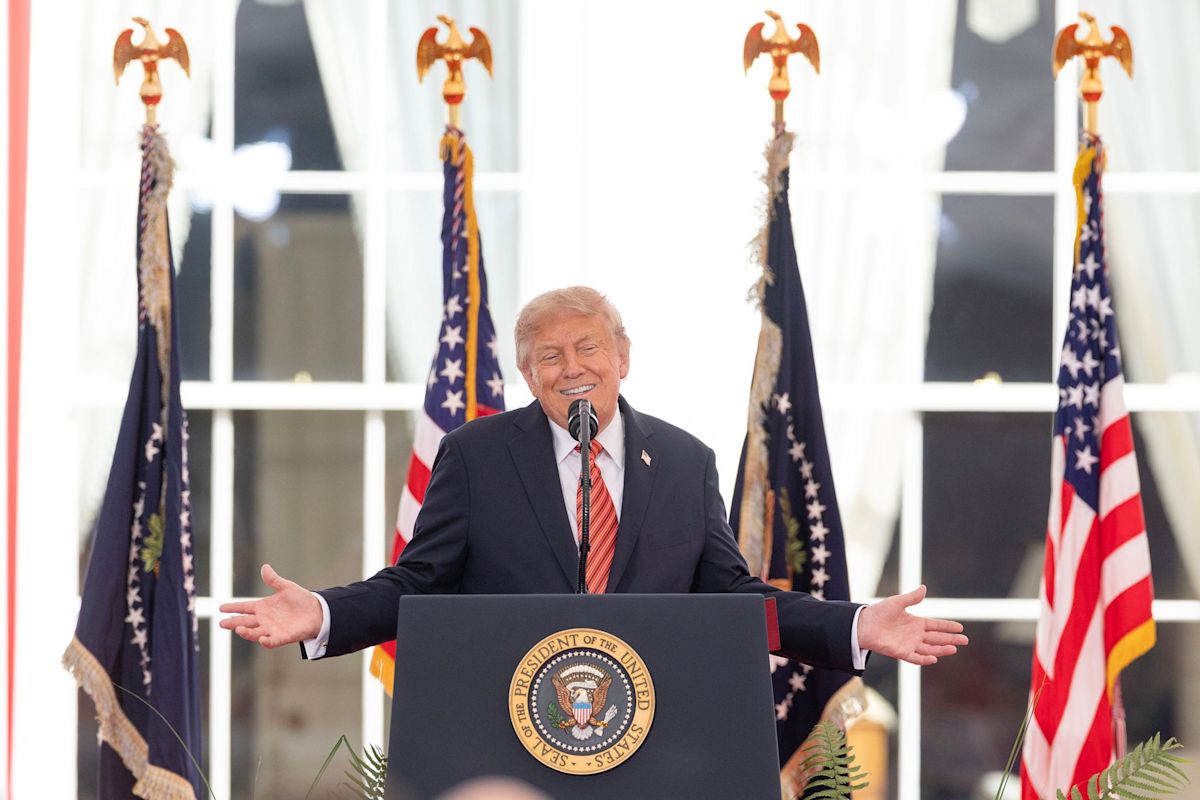
US President Donald Trump pushed forward with the second and final day of his visit to Ireland on Sunday, carrying out his schedule against the backdrop of an intense diplomatic dispute sparked by his public endorsement of Irish reunification.
Trump spent the morning at his private Trump International golf resort located in Doonbeg, County Clare. The coastal property served as the venue for the high-profile Amgen Irish Open, drawing premier golfing talent such as Rory McIlroy and Shane Lowry, alongside a substantial gathering of international spectators and media.
The American president, who spent Saturday evening observing tournament proceedings from an elevated balcony above the 18th green, was expected to take a more active role across the grounds on Sunday. Official plans outlined that Trump would personally present the winner's trophy to the tournament champion before concluding his tour and flying back to the United States.
Despite the political controversy surrounding the visit, Irish Premier Micheál Martin and several senior Irish government officials were also scheduled to attend the tournament's final round of play. Their joint presence on the course followed intense bilateral discussions held between the leaders a day earlier in the capital.
The diplomatic friction originated during Trump's engagements on Saturday, when he directly weighed in on the contentious constitutional future of the island. Responding to an inquiry from the Press Association following his meeting with Martin, Trump declared that he "would love to see" Ireland unified, further asserting that such an outcome was "going to happen eventually."
Trump had arrived in the country on Saturday morning aboard a Qatar-gifted Air Force One aircraft, touching down at Dublin Airport where he was initially received by Irish Deputy Premier Simon Harris. His initial stops included a meeting at Áras an Uachtaráin in Phoenix Park with Irish President Catherine Connolly, who has previously been recognized as a prominent critic of the US leader.
Throughout the presidential tour, a massive security deployment remained active across both Dublin and County Clare. Ireland's national police force, An Garda Síochána, maintained tight coordination with members of the Irish Defence Forces and the US Secret Service to safeguard the president and secure the perimeter surrounding the Doonbeg property.
Trump's arrival in Ireland elicited public demonstrations in several locations, including Dublin and the Clare area. In response to potential disruptions, Garda Commissioner Justin Kelly emphasized that law enforcement would exercise a strict zero-tolerance approach toward public disorder or any coordinated attempts to interfere with critical presidential movements.
Trump's commentary on Irish unity provoked immediate pushback across the Irish Sea from political figures in the United Kingdom. The British government moved to reiterate the position of Prime Minister Andy Burnham, who earlier in the week dismissed calls for an immediate border poll by emphasizing that such a referendum would only ever be entertained if there were a clear consensus within the country.
The official British stance echoed statements made earlier in the year by Prime Minister Burnham, who had previously created political friction of his own by declaring that a border poll was taken off the table. The Conservative opposition in London offered an even sharper denunciation of the US president's intervention.
Alex Burghart, the deputy leader of the UK Conservatives, condemned Trump's remarks, stating that the American president was very wrong in his assessment. Burghart stressed that Northern Ireland continues to remain an integral and indivisible part of the United Kingdom, rejecting any external characterization of its constitutional future.
The controversy threatened to place additional pressure on the transatlantic relationship between the US and the UK. Adding to the friction over Northern Ireland, Trump also publicly cast doubt during his trip on Britain's military ability to defend the Falkland Islands, raising further diplomatic alarm in Westminster.
The debate also exposed complex political fault lines inside Northern Ireland itself. Democratic Unionist Party (DUP) leader Gavin Robinson strongly rejected Trump's perspective, emphasizing that Northern Ireland's constitutional standing would be determined exclusively by its residents rather than through commentary coming out of London, Dublin, or Washington. Robinson firmly added that unionists have no appetite for the destruction of their country via integration into the Irish Republic.
Conversely, Sinn Féin president Mary Lou McDonald welcomed the US president's statements, describing them as timely and insisting that Premier Micheál Martin must immediately begin concrete planning for a united Ireland. The stance highlighted a shifting dynamic, given that Sinn Féin had previously chosen to boycott the traditional St. Patrick's Day diplomatic visits to Washington over objections to Trump's Middle East policies, whereas unionist groups like the DUP and UUP had maintained active engagement.
The debate over Irish reunification is fundamentally governed by the legal framework of the 1998 Belfast/Good Friday Agreement. Under the terms of the historic accord, the UK Northern Ireland Secretary possesses the authority and statutory obligation to call a border poll if it seems probable that a majority would vote for unity, with constitutional change also requiring a concurrent majority vote among citizens in the Republic of Ireland.








(0)