
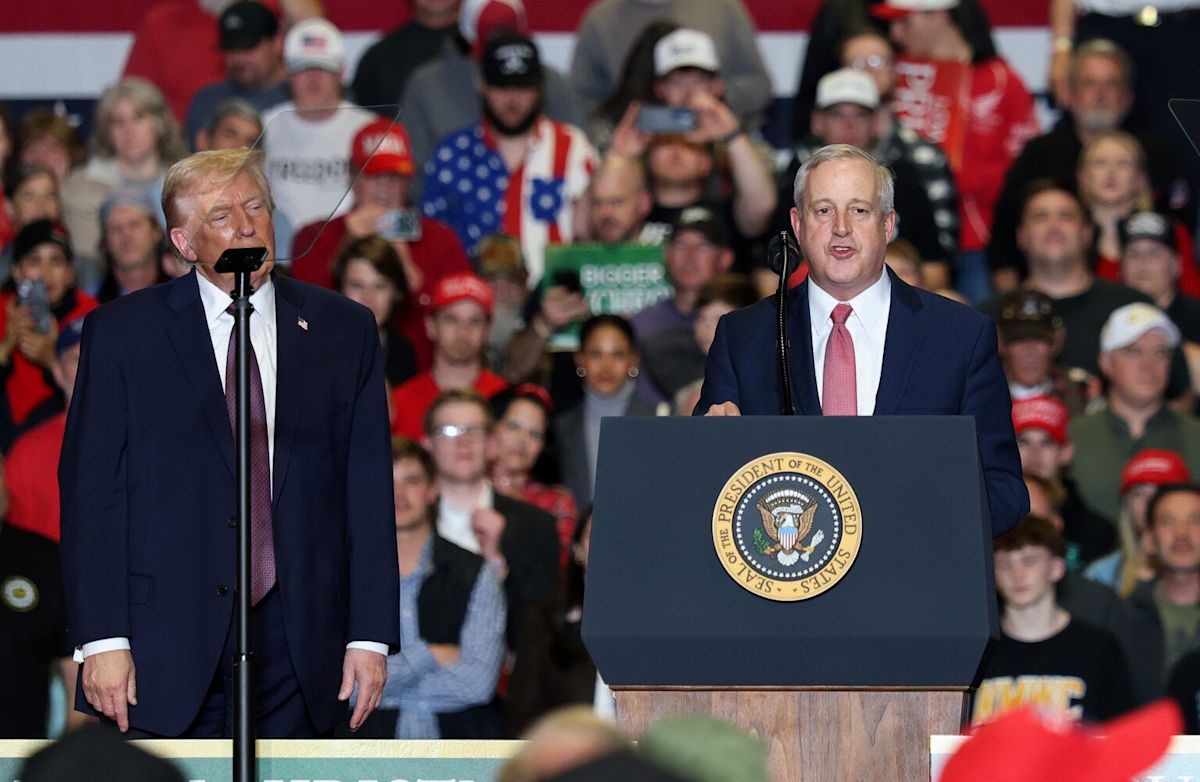
Donald Trump is scheduled to travel to North Carolina on Wednesday for a major campaign appearance alongside Republican U.S. Senate nominee Michael Whatley. The visit to Whatley’s hometown of Gastonia is widely seen as an unmistakable indication that national party leaders are increasingly concerned about preserving their hold on the crucial southern battleground state.
Whatley, who previously served as chairman of both the Republican National Committee and the North Carolina Republican Party, finds himself facing significant headwind in the contest. Recent polling and fundraising disclosures show him trailing behind the Democratic nominee, former Gov. Roy Cooper, as both campaigns gear up for the final stretch of the election season.
Welcoming the former president's travel plans, Whatley declared on social media that he was thrilled to host Trump in Gastonia. In his message, Whatley framed his campaign as a vital legislative partnership, asserting that Trump needs a reliable ally in the upper chamber while North Carolina requires a proven fighter, expressing confidence in a GOP victory on November 3.
The high-stakes contest is open this cycle due to the impending retirement of Republican U.S. Sen. Thom Tillis. With no incumbent defending the seat, nonpartisan analysts at the Cook Political Report have shifted their assessment of the North Carolina race to "lean Democrat," marking a serious defensive challenge for Republicans trying to maintain national power.
The outcome in North Carolina could ultimately decide the majority balance of the upper chamber. Currently, Republicans control 53 seats while Democrats hold 45, with two independent senators caucusing alongside the Democratic minority. Any single shift in the Senate tally carries major consequences for the chamber's balance of power.
Beyond the Tar Heel State, the national Republican campaign apparatus is managing a wide and complex midterm terrain. The GOP is working to defend open seats in typically conservative states like Iowa and Texas, while simultaneously defending incumbents in Alaska, Maine, and Ohio. At the same time, the party is hunting for potential takeover opportunities in Michigan, New Hampshire, and Georgia.
Running a statewide bid in North Carolina carries an exceptionally high price tag because of expensive media markets in the Charlotte and Raleigh-Durham metropolitan areas. These steep advertising costs may force both national parties to carefully evaluate their expenditures and triage financial resources across the broader national map.
Eric Heberlig, a political science professor at the University of North Carolina at Charlotte, noted that party strategists must make practical calculations about their path to a majority. Heberlig observed that Republicans could still maintain control of the Senate even if they fall short in North Carolina, leading strategists to determine where investments offer the strongest chance to mitigate broader losses.
A presidential visit highlights the national significance of the Senate race, even if Trump's personal standing in the state remains polarizing. With Trump’s approval rating hovering around 35% in North Carolina, political analysts do not expect the Gastonia event to sway undecided or moderate swing voters in meaningful numbers.
Instead, Heberlig explained that the appearance is primarily engineered to energize the Republican base. The chief priority is mobilizing low-propensity conservative voters who may be unfamiliar with Whatley and might otherwise sit out the midterm election. Heberlig noted that the path to victory requires retaining those who previously supported Trump, as well as senators Thom Tillis and Ted Budd, ensuring they turn out once more for the party ticket.
The visit could also provide an important turnout boost for a troubled congressional race in western North Carolina's 11th District. Following the withdrawal of former U.S. Rep. Chuck Edwards amid controversy, the state Republican Party selected state Rep. Jennifer Balkcom to run. Balkcom is facing Democratic candidate Jamie Ager, a fourth-generation farmer with deep political roots, in a district currently rated by the Cook Political Report as "lean Republican."
North Carolina has traditionally proven difficult for federal Democratic candidates, even as Democrats frequently win state-level executive races. The state has not elected a Democratic U.S. senator since 2008, the same year Barack Obama became the first Democratic presidential candidate to carry the state in 32 years. Since that election, no Democratic candidate for president or the U.S. Senate has prevailed in North Carolina.
Democrats, however, view Cooper as exceptionally well-positioned to break that losing streak. Cooper launched his general election campaign earlier this year in Raleigh with a policy focus centered on lowering food and grocery costs. As a two-term governor and a former four-term state attorney general—where his 16 years of service set a state record—Cooper is the most recognizable Senate candidate Democrats have fielded in decades.
Heberlig pointed out that Cooper’s track record of statewide electoral success gives Democrats a uniquely solid foundation of broad name recognition and personal popularity. Meanwhile, North Carolina Democratic Party Chair Anderson Clayton stated that Trump's campaign stop, paired with Whatley’s recent featured speaking slot at the GOP midterm convention in Dallas, demonstrates that Republicans are genuinely alarmed about their prospects in the state.





(0)