
The Renton City Council is poised to make a decisive move regarding homelessness and public space management as municipal leaders prepare to vote on a proposed ordinance that would prohibit camping on city-owned property. If approved, the measure would align Renton with a growing roster of jurisdictions across Washington State that have enacted strict limitations on where unhoused individuals can sleep, set up shelters, or store their personal effects.
The legislative push arrives in the wake of a pivotal legal benchmark set by the United States Supreme Court. The high court determined that local anti-camping ordinances do not breach the Eighth Amendment's constitutional protections against cruel and unusual punishment, granting municipalities nationwide expanded legal authority to regulate encampments and clear public grounds.
Following that federal judicial ruling, several neighboring communities within the region moved swiftly to enact their own municipal restrictions. Jurisdictions including Burien, Lakewood, and Tukwila established local frameworks barring outdoor encampments, setting a precedent that Renton councilmembers are now considering adopting within their own city limits.
Under the provisions of the proposed ordinance, individuals would be strictly prohibited from setting up tents or draping tarps across public property throughout Renton. The sweeping regulation covers an extensive array of civic spaces, specifically designating public parks, walking trails, municipal parking lots, and other publicly owned properties as off-limits for temporary dwelling structures.
Beyond the physical erection of tarps and tents, the draft legislation outlines comprehensive prohibitions against several related activities on municipal land. The measure explicitly forbids people from building open fires, leaving personal property unattended, or storing shopping carts anywhere on municipal grounds, effectively targeting the standard components of makeshift outdoor camps.
For individuals residing on the streets, the council’s impending decision threatens to drastically reduce the few remaining places where they can find temporary refuge. Downtown Renton has become a daily refuge for people like Nicole, who has navigated life without permanent housing for three to four years after experiencing severe personal losses that left her with nothing.
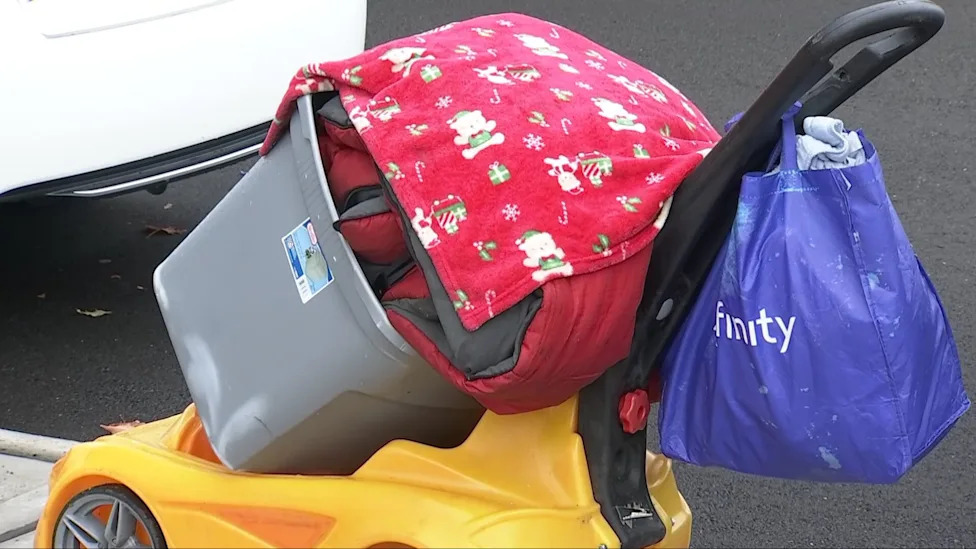
Navigating the sidewalks of downtown Renton, Nicole transports what is left of her possessions packed onto a small child’s push car. In her day-to-day existence, she typically seeks out empty parking lots as places to rest and sleep at night, a habit that would be directly outlawed if the council passes the draft regulations currently before them.
While emergency housing is often presented as the primary alternative to life on the streets, Nicole expressed profound hesitation regarding local shelter facilities. She noted that deep mistrust and concerns over unhygienic environments have led her to actively avoid such institutions, stating that she feels significantly safer remaining outdoors despite the inherent difficulties of street life.
To enforce compliance, the proposed municipal ordinance introduces a structured system of trespassing zones across public areas. Under this enforcement model, individuals who repeatedly refuse to vacate designated city properties can be subjected to formal legal intervention by law enforcement authorities.
The penalties outlined in the measure carry significant legal weight for repeat offenders who violate the city's camping prohibitions. Under the proposed statute, recurring infractions can be prosecuted as misdemeanors, which carry potential sentences of up to 90 days of incarceration and monetary fines reaching up to $1,000.
Despite the punitive measures included in the draft legislation, the proposal specifies that enforcement must be accompanied by proactive support. Renton’s proposed policy dictates that city outreach personnel and partner service providers are required to connect unhoused residents with available social services and assistance programs before or during enforcement actions.
Advocates working in addiction recovery and community support emphasize that an effective municipal response requires balancing strict enforcement with genuine assistance. Max Komar, representing the non-profit organization Battlefield Addiction, noted that public policy must weave together accountability and empathy to effectively address the crisis visible on local streets.
Komar’s organization regularly interacts with vulnerable individuals who are battling severe substance use disorders, many of whom ultimately find themselves living within unsanctioned outdoor camps. While recognizing the urgent need to support unhoused populations, Komar stressed that local neighborhoods and resident families also require security and stability.
From the perspective of Battlefield Addiction, municipal policies must protect neighborhood safety by reducing open-air drug activity and eliminating unsafe encampments. At the same time, Komar emphasized that such measures should serve as a conduit to link struggling individuals with structured recovery pipelines, treatment resources, and supportive aid.
As the scheduled Monday vote approaches, the council faces the challenging task of reconciling community safety standards with the immediate realities of unhoused individuals. The outcome of the council's decision will determine how Renton manages its shared spaces while defining the legal and practical options available to its most vulnerable residents.









(0)