
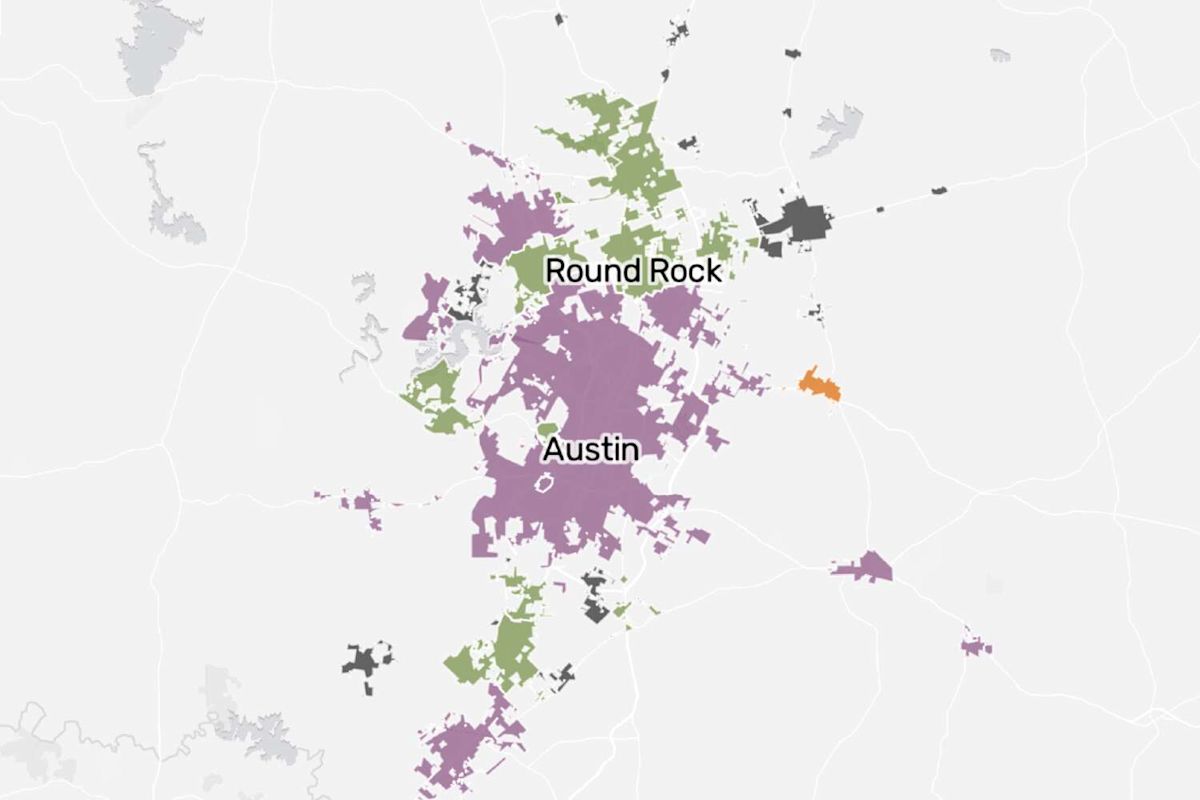
Central Texas has become deeply divided over the deployment of automated license plate reader technology, with municipal leaders taking starkly different approaches to automated surveillance cameras. An extensive review of city records, news reports, and local government disclosures across Travis, Williamson, Hays, and Bastrop counties reveals a fractured landscape where some cities are expanding camera networks while others are dismantling them.
At the center of the dispute is Atlanta-based vendor Flock Safety, whose camera systems have sparked significant public pushback across the region. A comprehensive examination of area jurisdictions indicates that while nine communities continue to utilize license plate reader technology, another nine have officially terminated their contracts, one has temporarily halted operations, and three have reported no use of the surveillance tools.
The nine municipalities actively maintaining their automated license plate reader programs include Bee Cave, Buda, Cedar Park, Georgetown, Hutto, Lakeway, Mustang Ridge, Round Rock, and West Lake Hills. In these communities, local police departments rely on the automated cameras to scan passing traffic, cross-referencing vehicle license plates against regional and national databases in real time.
Supporters of the camera networks argue that the technology provides an indispensable law enforcement asset. Proponents emphasize that automated plate readers enable officers to swiftly locate stolen automobiles, track down missing individuals, and identify vehicles tied to active criminal suspects. Law enforcement agencies often highlight how rapid alerts help patrol officers respond to threats faster than traditional policing methods allow.
Conversely, privacy advocates and concerned residents contend that the pervasive deployment of cameras constitutes a form of mass surveillance. Critics warn that accumulating searchable logs of vehicle movements creates detailed digital trails of law-abiding drivers. These concerns are amplified when data is retained over extended periods or shared across regional and national networks accessible by multiple outside law enforcement agencies.
The regional backlash gained significant momentum following an incident in Pflugerville, where a resident submitted records requests seeking logs of outside agencies searching the city's Flock database. Prompted by concerns over external access to local vehicular records, the Pflugerville City Council voted on August 25 to cancel its contract with the vendor.
Pflugerville's decision initiated a rapid succession of policy reversals across neighboring jurisdictions. Officials in Bastrop, Elgin, Manor, and Leander quickly moved to terminate or reevaluate their camera programs. Bastrop went a step further than its neighbors, with city council members voting not only to drop their vendor contract but also to enact a municipal ban prohibiting the use of automated license plate reader technology entirely.
The municipal contract cancellations coincided with directives at the state level. Texas Governor Greg Abbott issued an order prohibiting state agencies from allocating public funds toward Flock camera systems, reinforcing regional skepticism and adding momentum to local efforts to remove the devices from public roadways.
In total, nine Central Texas cities have cancelled their agreements with license plate reader vendors: Austin, Bastrop, Lago Vista, Leander, Liberty Hill, Manor, Pflugerville, San Marcos, and Sunset Valley. Meanwhile, Elgin opted to place a temporary pause on its camera program while local officials evaluate the technology's future within the community.
The situation in Austin illustrates the complex regulatory challenges surrounding license plate data. Austin's direct contract with Flock expired in 2025, ending the Austin Police Department’s direct access to the vendor’s centralized database. However, Austin officers can still obtain plate reader information through partner law enforcement agencies that maintain active, lawful access to the surveillance network.
This indirect data-sharing arrangement has drawn scrutiny because the city of Austin does not track these incoming requests or maintain formal written agreements governing such exchanges. The absence of documented protocols has raised serious questions among privacy advocates regarding how often officers rely on third-party camera feeds and whether municipal surveillance oversight policies are being bypassed.
Taking a different path, the Kyle City Council declined on September 5 to cancel its municipal contract with Flock, despite facing vocal public opposition. Instead of terminating the program immediately, Kyle officials are considering placing a nonbinding advisory proposition on the May 2027 ballot, allowing registered voters to decide whether the city should continue utilizing license plate readers.
Elsewhere in the region, several communities have avoided the controversy altogether by steering clear of the systems. Officials in Dripping Springs, Rollingwood, and Smithville have confirmed that their local agencies do not deploy automated license plate reader technology.
However, the full scope of surveillance across Central Texas remains incomplete. Local officials in 12 municipalities—Bartlett, Coupland, Creedmoor, Florence, Granger, Jarrell, Jonestown, Taylor, Thorndale, Thrall, Weir, and Wimberley—did not respond to inquiries regarding whether their police departments or local governments utilize automated license plate readers.
As debates over police technology, data security, and civil liberties continue to evolve across Texas, the divided municipal policies reflect a growing struggle to balance technological crime-fighting tools against public demands for privacy and transparency.





(0)