
The Witte Museum has officially opened a comprehensive new exhibition exploring the rich culinary heritage of the Lone Star State, titled "Gather 'Round the Table: Texas Food Traditions." Designed to coincide with the institution’s milestone 100th anniversary celebration, the expansive showcase offers visitors an in-depth look at regional foodways, historical artifacts, and iconic dining customs. The exhibition is scheduled to remain on public display through February 7, 2027.
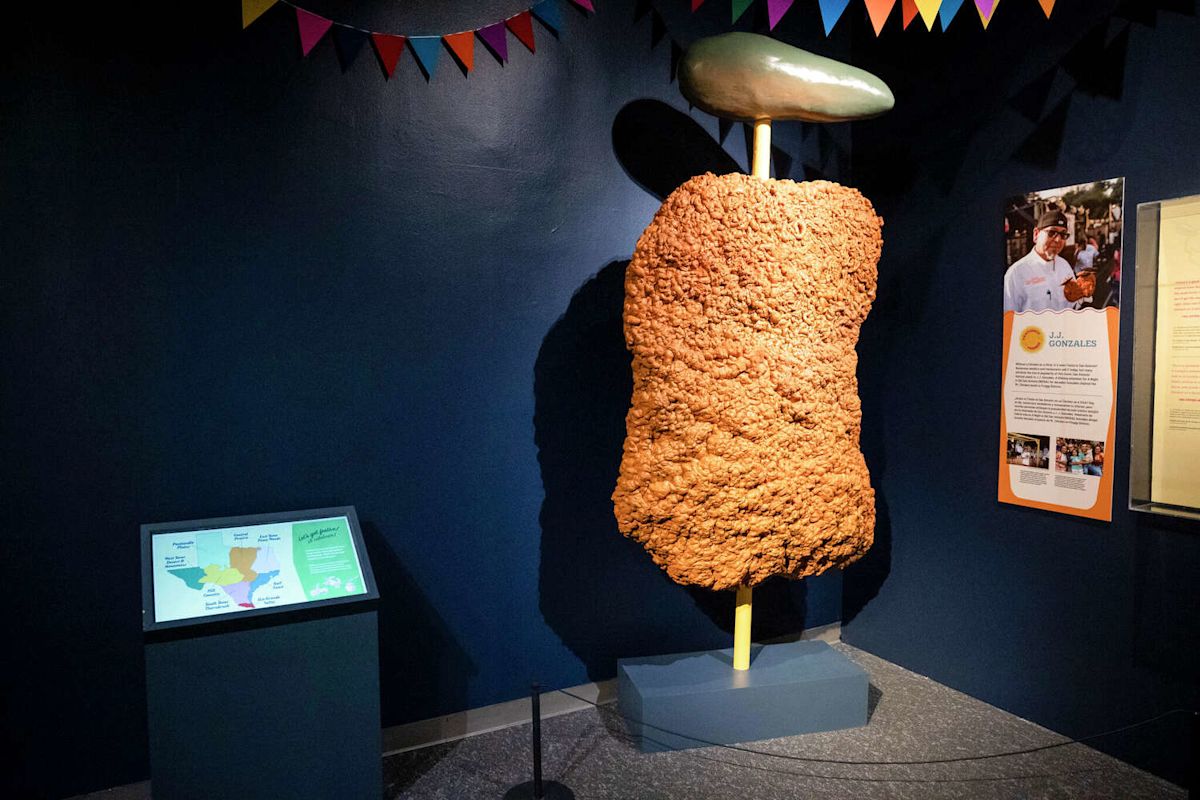
Serving as one of the most eye-catching centerpieces of the exhibition is a towering, ten-foot-tall chicken-on-a-stick sculpture. The oversized artistic creation was designed and constructed by Marcos Medellin, the director of exhibitions at the Witte Museum. Resembling the beloved carnival and festival staple, the giant faux delicacy is detailed with a thick golden-brown fried crust and comes complete with a plump green jalapeño pepper skewered at the top of a bright yellow post.
While the sculpture appears appetizing enough to serve a crowd, Medellin built the towering installation entirely out of non-edible workshop materials. The exhibition director crafted the piece utilizing repurposed scrap wood found around the shop, standard chicken wire, expanding insulation foam, and durable PVC piping. The resulting installation serves as an immediately recognizable tribute to Texas festival gastronomy and provides a popular photo opportunity for visitors of all ages.
The creation of the massive food sculpture and the broader exhibition reflects the talent of the museum's internal team. Michelle Everidge, the president and chief executive officer of the Witte Museum, emphasized that the centennial exhibition demonstrates the institution performing at its absolute best. Everidge noted that developing such extensive exhibitions in-house, complete with large-scale artistic fabrications and authentic historical artifacts, makes the showcase a fitting centerpiece for the museum's 100th birthday.
Curators made sure that popular celebration foods were prominently featured in the show. Nalleli Guillen, the museum's vice president of interpretation and curator of history, explained that including chicken on a stick was considered an absolute necessity from the earliest stages of planning. Guillen recalled being advised early on that omitting the iconic skewered dish from a discussion of Texas festival culture would draw fierce criticism from local food enthusiasts, making its inclusion mandatory.
Beyond festival foods, the exhibition engages visitors with thoughtful commentary on quintessential Texas food culture and culinary debates. The displays explore longstanding regional discussions, such as the preferences between flour and corn tortillas or the merits of salsa versus guacamole. Throughout the galleries, the exhibition breaks down accessible information regarding the diverse dishes Texans cook, the methods they employ, and the cultural reasons behind their culinary choices.
In addition to modern food culture and festival art, the exhibition features rare historical artifacts from the museum's permanent archives, including an early 20th-century pecan shadow box. Assembled by naturalist H.P. Attwater, the historic display highlights the astonishing diversity of Texas's native nut. While more than 1,000 varieties of pecans exist, Attwater dedicated significant effort to collecting, preserving, and categorizing numerous distinct specimens rather than simply viewing them as a snack.
The vintage wooden shadow box contains carefully preserved groupings of 50 different pecan varieties, each presented in sets of three nuts. Directly beneath each trio, vintage typewritten labels identify specific cultivars, ranging from slender May Russells and round sweetmeats to delicate-looking Mexican Papershells, alongside dozens of other documented regional varieties.
Beyond representing the agricultural heritage of the state and evoking thoughts of traditional desserts like pecan pie, the shadow box carries immense historical weight for the museum itself. The artifact forms part of the Attwater Collection of Natural History, which holds the distinction of being the very first major acquisition made by the Witte Museum prior to its opening.
The purchase of the Attwater collection was spearheaded by Ellen Schulz Quillin, a botanist and schoolteacher who served as the driving force behind the museum's founding. Quillin acquired the significant natural history collection for $5,000, relying heavily on grassroots fundraising efforts. A substantial portion of the necessary funds was collected through small donations of nickels and dimes gathered by Quillin's own students.
Items from the Attwater collection were among the primary displays when the cultural institution initially opened its doors to the public on October 8, 1926. At the time of its grand opening, the facility was named the Witte Memorial Museum. The institution maintained that original designation for nearly six decades before officially dropping the word "Memorial" from its name in 1984.
The exhibition also incorporates interactive and multi-sensory components to engage visitors beyond visual artifacts. Among these interactive elements is an olfactory installation that allows museum guests to smell eight distinct culinary spices commonly utilized in Texas cooking, adding a sensory dimension to the exploration of state recipes and seasonings.
Through its combination of playful custom sculptures, engaging historical debates, and foundational museum artifacts, "Gather 'Round the Table: Texas Food Traditions" serves as both a cultural reflection on regional foodways and a tribute to the museum's century-long institutional history. The exhibition invites visitors to reflect on how communal dining and historic collections continue to shape Texas identity today.





(0)