
A seasoned aviation journalist and veteran helicopter pilot has presented an initial evaluation of a fatal helicopter crash in Southern California, suggesting that a severe mechanical malfunction preceded the tragedy. Zoey Tur, renowned for pioneering aerial news coverage over the skies of Southern California, reviewed audio recordings captured around the time of the disaster and pointed to distinct acoustic indicators of an engine failure moments prior to the aircraft's impact.
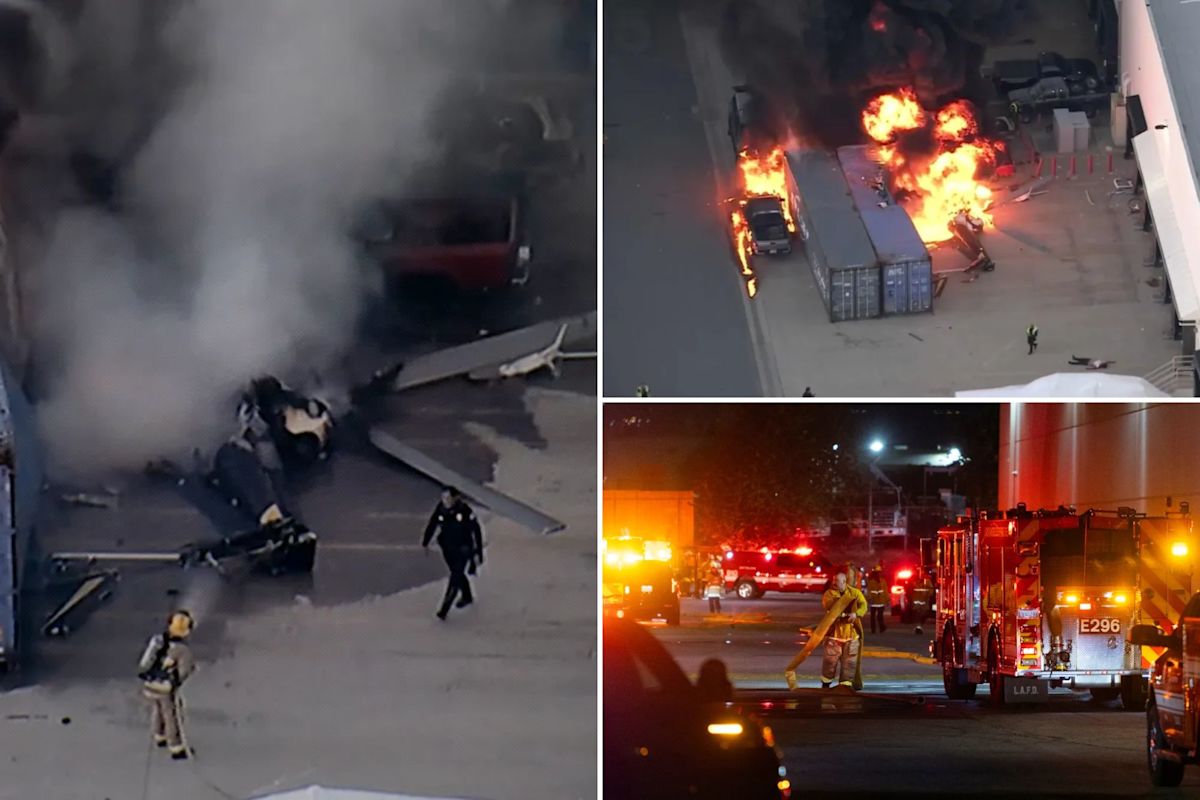
The fatal incident occurred in the Chatsworth district of northern Los Angeles, where the aircraft plummeted between two commercial structures. Ground imagery from the scene depicted emergency personnel maneuvering around adjacent industrial buildings and shipping containers, where the wreckage burst into flames upon striking the ground. The crash occurred in close proximity to the site of an earlier Los Angeles Metro bus collision, compounding the emergency response efforts in the surrounding neighborhood.
Emergency personnel from the Los Angeles Fire Department quickly mobilized to secure the crash area and extinguish the ensuing blaze. Authorities confirmed that the accident resulted in three deaths at the scene, while a fourth person survived the initial impact and was rushed to a local medical facility for treatment. Responders encountered heavy smoke and burning debris scattered across the alleyway separating the industrial properties.
In a technical analysis shared publicly, Tur noted specific warning signals evident on the audio recordings from the scene. The veteran pilot identified the sound of a cockpit warning system designed to alert pilots when the main rotor blades lose operational rotational velocity. According to Tur, the activation of this low rotor RPM horn served as a crucial sign that the aircraft's critical systems were deteriorating rapidly in the air.
Tur further noted that the acoustic profile of the aircraft indicated a noticeable revving down of the powerplant prior to ground contact. In Tur's assessment, the audio evidence pointed directly toward an sudden engine failure that left the pilot in command with very little time or altitude to manage the unfolding crisis.
Beyond the initial power loss, Tur suggested that the aircraft's descent indicated a delayed transition into autorotation by the pilot in command. Autorotation is a critical emergency aerodynamic maneuver in which the downward airflow drives the rotor blades to generate lift, allowing a pilot to attempt a survivable landing without engine power. In Tur's preliminary view, the sequence of mechanical loss and subsequent handling prevented a controlled touchdown, prompting a blunt early assessment that there would be no survivors.
Federal safety authorities have stepped in to launch an official probe into the circumstances leading up to the fatal incident. The National Transportation Safety Board is serving as the primary investigative body charged with uncovering the probable cause of the crash. Investigators will examine the wreckage, review maintenance logs, scrutinize meteorological data, and analyze any available flight recordings to piece together the helicopter's final moments.
Operating in parallel with safety investigators, the Federal Aviation Administration is actively conducting its own inquiry into the incident. The FAA's regulatory branch is responsible for reviewing licensing credentials, airworthiness certifications, and overall compliance with federal aviation standards governing the flight.
Despite early assessments provided by independent aviation professionals, federal authorities have underscored that an official determination of the cause remains undetermined. Investigators typically reserve final conclusions until all mechanical components, airframe integrity, pilot performance, and environmental factors have undergone thorough forensic analysis.
Tur brings extensive background to the public analysis of aerial events, having spent decades operating helicopters in high-stress urban environments. Alongside then-wife Marika Gerrard, Tur formed an aerial reporting team that transformed breaking news coverage across the Los Angeles metropolitan area, establishing a distinctive standard for live airborne television journalism.
Throughout a distinguished broadcast career, Tur's aerial operations achieved several historic milestones in local and national news reporting. Tur's team was the first to transmit live television coverage of a high-speed police chase through Los Angeles streets, popularizing a format that would become a staple of American news broadcasting.
Tur was also responsible for filming some of the most enduring aerial imagery in modern media history. In 1992, Tur captured live footage of the beating of truck driver Reginald Denny at the intersection of Florence and Normandie avenues during the Los Angeles riots, providing the world with an unfiltered view of the unfolding civil unrest from above.
Two years later, Tur tracked and broadcast the slow-speed pursuit of O.J. Simpson's white Ford Bronco along Southern California freeways in 1994, an event that captivated a global audience and redefined television news capabilities. Over the course of a career marked by groundbreaking work, Tur earned multiple Emmy Awards and Edward R. Murrow honors for excellence in journalism.
As the community of Chatsworth processes the deadly event and first responders conclude on-site operations, federal investigators continue their work to determine what caused the aircraft to go down. The National Transportation Safety Board's full factual findings and final report are expected to provide definitive clarity on whether mechanical failure, operational challenges, or other factors led to the tragedy.





(0)