
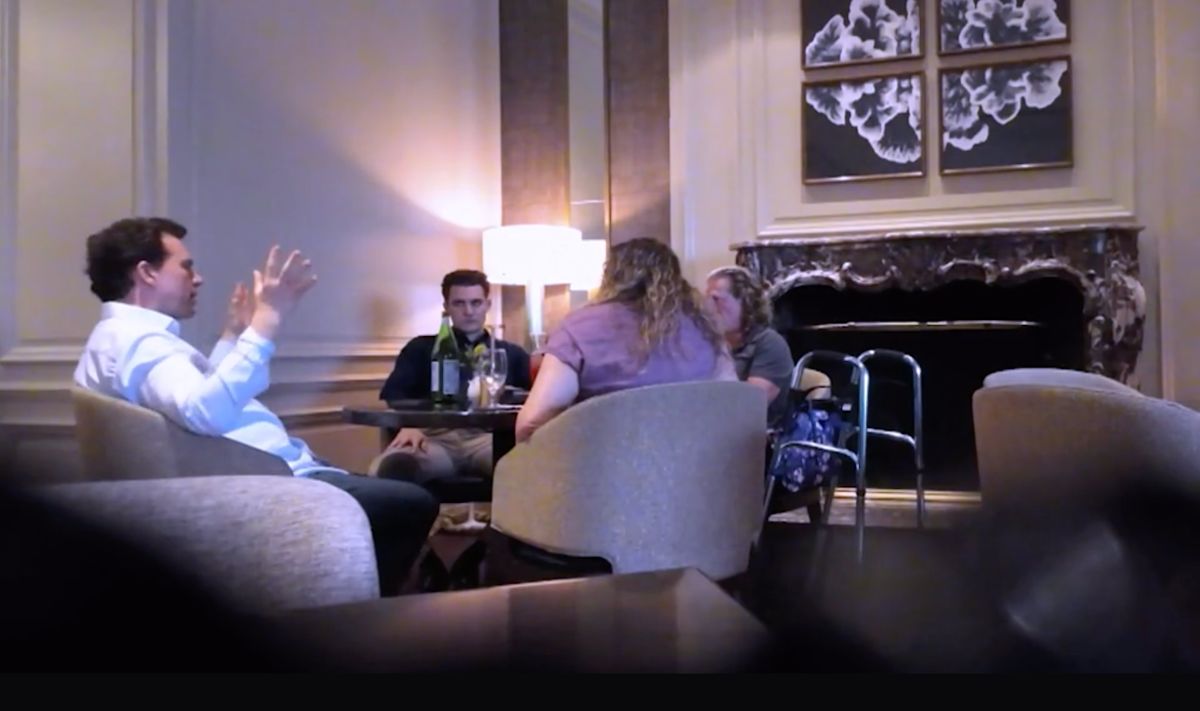
A covert investigation into the flourishing business of executive clemency has pulled back the curtain on a lucrative marketplace where intermediaries promise access to the White House for hundreds of thousands of dollars. The operation, documented on hidden cameras, captures how political operatives now market their ability to bypass traditional administrative channels and directly influence presidential decision-making for paying clients.
The inner workings of this burgeoning enterprise were captured inside a high-end bar at the Ritz-Carlton hotel in Tysons Corner, Virginia, situated just outside the nation's capital. Sitting across from a prospective customer, conservative lobbyists Jack Burkman and Jacob Wohl laid out a strategy designed to steer a clemency bid through unorthodox pressure campaigns rather than official bureaucratic reviews.
Explaining their operational philosophy to the applicant, Burkman insisted that navigating the current administration requires relentless and coordinated pressure from multiple directions to effectively force the president's hand. He and Wohl characterized their method as one emphasizing raw energy, aggressive outreach, and personal connections over conventional paperwork and government protocols.
The operatives believed they were pitching their services to Ammon Covino, a convicted felon who previously served nearly two years in federal custody for illegally transporting a stingray and a shark across state lines, alongside his wife, Crystal. In exchange for a $300,000 fee, Burkman and Wohl boasted that they could secure a full presidential pardon as early as October.
Unbeknownst to the lobbyists, the encounter was an undercover operation coordinated by CBS News' "60 Minutes." Covino was not seeking their representation, but had agreed to approach the brokers while outfitted with recording equipment to provide an inside look into how these shadow clemency campaigns are pitched and executed.
Covino had previously pursued executive mercy through the standard administrative avenue, submitting a written petition directly to the Department of Justice during the Biden administration. However, his petition was officially denied in July under President Trump as the administration moved to clear out a large backlog of pending applicant files, leaving unconventional channels as his remaining option.
The pitch by Burkman and Wohl reflects a profound shift in how presidential clemency is sought and granted over the past 18 months. Immediately upon taking office, President Trump executed sweeping clemency actions, clearing over 1,500 individuals charged or convicted in connection with the Jan. 6 Capitol riot through dismissals, pardons, and commutations, followed by dozens of grants to well-connected, affluent white-collar offenders.
Historically, the route to presidential mercy was administered by more than two dozen career attorneys inside the Justice Department. These officials were charged with methodically examining clemency applications, weighing an applicant’s demonstrated remorse and evidence of post-conviction rehabilitation, and submitting formal recommendations to the Oval Office.
Under the current administration, that established review mechanism has been largely marginalized in favor of direct appeals. According to a CBS News review of Justice Department records, approximately 70 percent of Trump’s second-term clemency decisions completely bypassed the DOJ's review structure, a figure that surges to 92 percent when factoring in the mass actions related to the Jan. 6 Capitol riot.
To navigate this altered landscape, pardon brokers market their personal networks, White House contacts, and allied MAGA influencers to place petitions directly in front of the president. Because physical and political proximity to executive power has become the premier commodity, sources familiar with the practice report that intermediary fees have escalated to as much as $3 million.
Controversial presidential pardons are not without historical precedent, having stirred intense public debate across multiple administrations. President Gerald Ford famously pardoned former President Richard Nixon, President Jimmy Carter granted broad clemency to Vietnam War draft evaders, and President Bill Clinton issued a last-day pardon to fugitive financier Marc Rich, whose spouse was a prominent donor to the Clinton presidential library foundation.
More recently, President Joe Biden faced significant scrutiny in December 2024 after issuing late-term pardons to allies, donors, and family members. Among those clemency recipients was his son, Hunter Biden, who had faced firearms convictions and entered a guilty plea on federal tax evasion charges, alongside a preemptive grant of clemency for Dr. Anthony Fauci.
Despite these historical controversies, federal prosecutors, defense practitioners, and legal scholars maintain that the scale and commercialization of the modern pardon economy are unprecedented. Legal professionals describe the current climate as an unregulated frontier where institutional traditions have been supplanted by high-dollar influence and transactional lobbying.
Legal experts warn that this commercialized environment fundamentally distorts an executive power originally intended as an equitable avenue for mercy. Mark Osler, a law professor at the University of St. Thomas in Minnesota who oversees a pro bono legal clinic helping federal inmates apply for clemency, noted that a constitutional process meant to be universally accessible and free of charge has transformed into an exclusive pay-to-play arena.
According to Osler, applicants are increasingly conditioned to believe that formal petitions are futile compared to buying access through intermediaries who can reach the president at his Mar-a-Lago estate or through high-priced acquaintances of White House legal staff. This dynamic highlights the extent to which executive mercy has evolved from a formal legal review into a high-stakes, lucrative brokerage industry.


(0)