
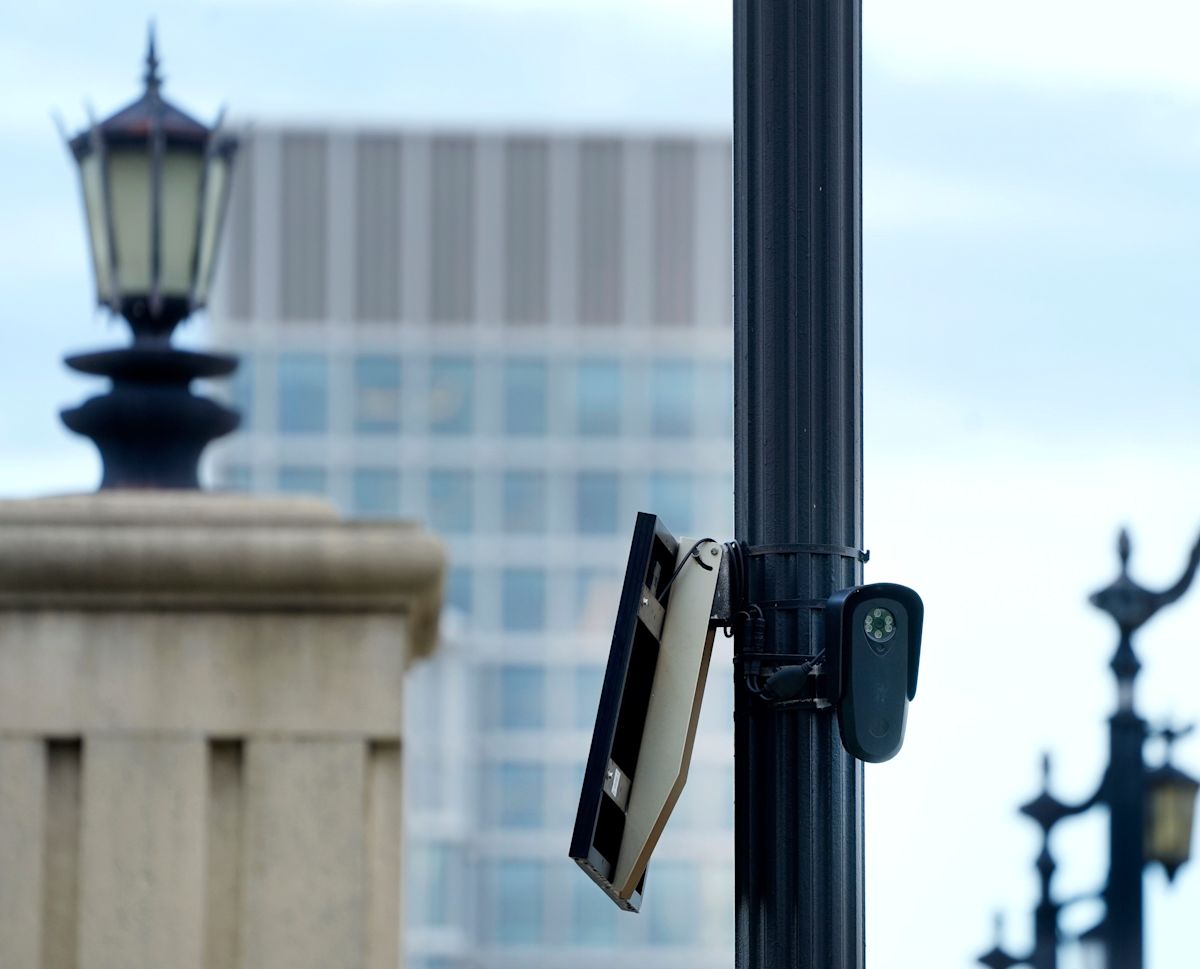
A regulatory decision by state transportation officials has triggered a wider policy discussion across Alachua County regarding the use, oversight, and privacy implications of automated license plate reader technology. The debate comes as local law enforcement agencies begin dismantling dozens of roadside cameras to comply with newly enforced state highway guidelines, even as questions persist over how the remaining surveillance network should be governed.
The shift follows an August 31 directive from the Florida Department of Transportation, which formally revoked general use permits previously granted for license plate readers situated within state highway rights-of-way. Under the state agency's order, municipal and county law enforcement departments were allotted a 30-day grace period to decommission and remove all non-compliant scanning equipment installed along state-managed corridors.
Following the state's announcement, Alachua County Sheriff Chad Scott identified 27 automated license plate readers within the county that fall under the criteria set by the transportation department. While these specific units are being taken down to satisfy state regulations, the broader surveillance infrastructure has not disappeared, as cameras erected outside state rights-of-way continue to capture vehicle movements across the area.
The rapid implementation of the state order has drawn attention to an issue that local civic advocates had already brought before elected leaders. Prior to the state's intervention, independent researcher and organ recovery surgical coordinator Sam Cornell formally presented the matter to the Alachua County Commission, urging local officials to establish meaningful municipal boundaries around the automated tracking system.
During that presentation, all five county commissioners agreed that the local license plate reader program warranted a closer and more comprehensive review. Community members emphasized that the goal was not necessarily to eliminate the investigative devices altogether, but rather to construct clear and enforceable public guardrails to govern their day-to-day deployment and data management.
Advocates specifically requested that the county adopt four key policy measures: establishing significantly shorter data retention schedules, mandating independent and authentic audits, enforcing complete transparency regarding which external agencies can access vehicle logs, and providing a full accounting of the program's overall financial costs to taxpayers.
The state department's sweeping permit revocation coincided with a summer-long investigation conducted through Florida public records requests. That inquiry had initially set out to determine whether local automated plate readers held valid and properly filed state transportation permits, culminating unexpectedly in the state's comprehensive shutdown of rights-of-way authorizations.
Despite the abrupt removal of the 27 units, local officials and researchers agree that automated license plate readers have demonstrated practical investigative utility for law enforcement. Sheriff Scott has reported that data collected by the optical network has directly assisted investigators in solving serious criminal offenses, including homicides, armed robberies, missing-person searches, and vehicle thefts.
The technology's investigative track record extends across regional borders as well. In neighboring Lake County, public records released to researchers detailed approximately two dozen case summaries where automated license plate scans played a pivotal role in aiding law enforcement personnel with ongoing criminal inquiries.
Nevertheless, privacy advocates and law enforcement leadership have both recognized the sensitive civil liberties questions raised by pervasive vehicle monitoring. Sheriff Scott recently noted that the vast majority of motorists photographed by roadside cameras are everyday citizens traveling to work or transporting children to school, emphasizing that ordinary commuters are not criminal suspects and must not be treated as such.
According to Sheriff Scott, the fundamental questions confronting the community revolve around defining what information is gathered, determining how long vehicle records should be stored in databases, controlling who receives search privileges, and establishing clear thresholds for what constitutes a legitimate investigative query.
The ongoing conversation in Alachua County has been characterized by unusual cooperation between local authorities and public record researchers. When detailed documentation about the camera network was requested earlier this year, the Alachua County Sheriff's Office supplied the complete records without cost in roughly one week, enabling an evidence-based public review rather than an adversarial confrontation.
Further discussions between citizen representatives and sheriff's office personnel are scheduled to take place soon to examine administrative practices and review potential safeguards. Community advocates have indicated they will publicly acknowledge any sound and transparent policies implemented by local law enforcement leadership during these upcoming consultations.
Civic observers point out, however, that geographic boundary lines set by transportation authorities cannot serve as an effective substitute for comprehensive local privacy protections. Because automated cameras outside state highway zones remain fully functional, an agency boundary line merely dictates where hardware may physically stand rather than defining how citizen data ought to be shielded.
The unfolding situation in Alachua County reflects a broader regional challenge where rapid surveillance technology deployment outpaced formal community consent. With state mandates now forcing physical changes on local roadways, county leaders and residents face the task of creating public rules that balance modern law enforcement capabilities with robust privacy safeguards.





(0)