
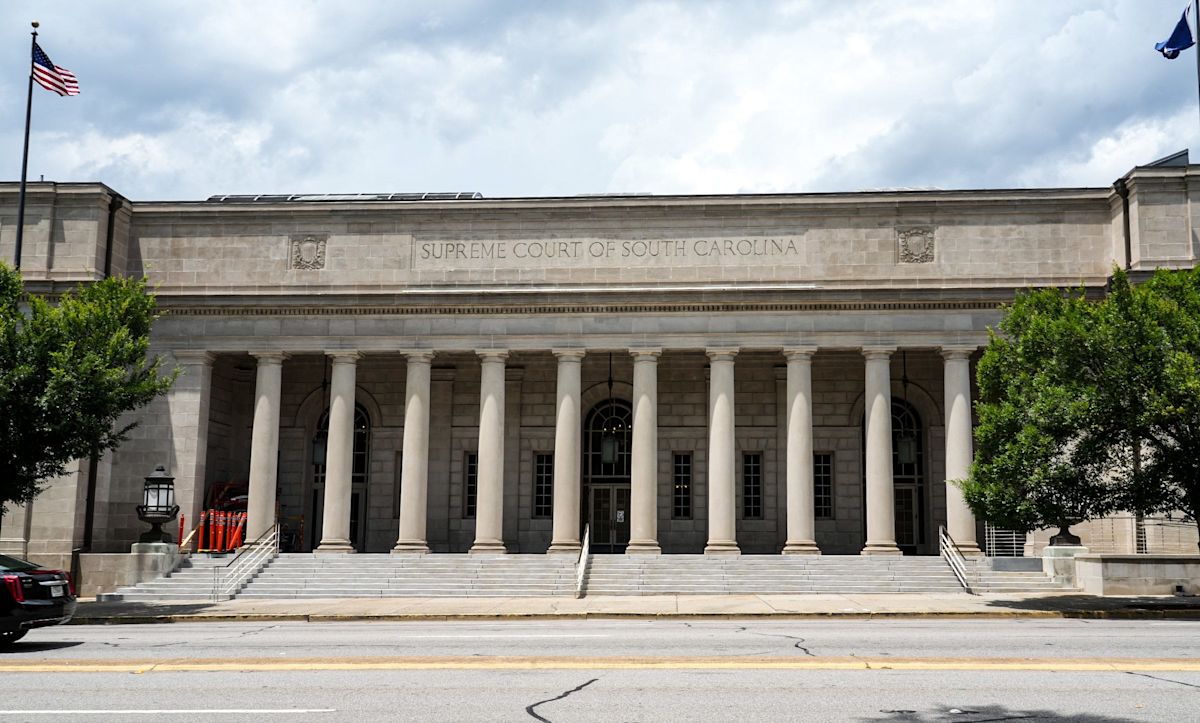
The South Carolina Supreme Court convened on the campus of Clemson University on Sept. 15 to hear oral arguments concerning the legality of Gov. Henry McMaster's executive decision to send state National Guard members to Washington, D.C. The high-profile proceedings were organized as part of a broader judicial initiative designed to increase institutional transparency and foster greater public engagement with the state's legal system.
The two-day series of hearings, scheduled to continue through Sept. 16, represents a historic milestone for both the judiciary and the university, marking the very first time that the state’s highest appellate court has conducted formal proceedings at Clemson University.
University leadership highlighted the educational significance of welcoming the state’s top jurists to the upstate campus. Clemson President Benjamin Ayers emphasized that the open court sessions offer an invaluable opportunity for members of the public and the student body to witness the operational reality of the judicial branch firsthand.
Ayers noted that hosting such proceedings serves as an important bridge between formal classroom study and the practical work of public institutions and state officials. He expressed gratitude toward the justices for bringing the live appellate experience directly to the university community.
The central legal controversy examined during the initial morning session stemmed from McMaster's decision in 2025 to deploy units of the South Carolina National Guard to the federal capital. That mobilization took place in coordination with a broader initiative championed by President Donald Trump aimed at suppressing criminal activity within the District of Columbia.
South Carolina was not alone in deploying military personnel to the nation's capital during that period. Republican governors from several other conservative states, including Tennessee, Mississippi, and Louisiana, also mobilized their respective state national guard units to Washington throughout 2025.
In response to the governor's actions, a legal challenge was mounted by the South Carolina Public Interest Foundation alongside James Weninger, a United States Navy veteran. The lawsuit formally named McMaster and Maj. Gen. Robert B. Stilwell, the adjutant general overseeing the South Carolina National Guard, as defendants in the action.
The plaintiffs contended in their filings that the governor exceeded his constitutional and statutory remit by ordering the activation. Specifically, they asserted that McMaster unlawfully dispatched state guard members to Washington, D.C., to carry out civilian policing duties rather than lawful military objectives.
During oral arguments before the full bench, ACLU of South Carolina Legal Director Allen Chaney presented the case on behalf of the plaintiffs. The courtroom debate quickly turned to the statutory scope governing gubernatorial power and the precise boundaries of executive discretion in mobilizing armed service members.
Chaney clarified the core focus of the legal challenge, maintaining that the lawsuit was not designed to question whether sending guard units to the capital was prudent policy. Instead, he underscored that the sole legal issue before the justices was whether existing legislative statutes legitimately empower the governor to order such deployments under the specific conditions presented.
Chief Justice John Kittredge directed sharp inquiries toward the plaintiffs regarding the principle of separation of powers. Kittredge asked whether the judicial branch possesses the legitimate authority to intervene in executive decision-making and dictate how a sitting governor should exercise discretionary command over the military.
Addressing the chief justice's questions on jurisdiction and separation of powers, Chaney asserted that judicial review is essential to maintaining constitutional limits. He argued that the state constitution must function as the supreme law, ensuring that no executive officer operates outside established legal boundaries.
Representing the executive branch, Grayson Lambert, legal counsel for McMaster, defended the deployment by pointing to the governor's sweeping constitutional authority. Lambert maintained that as commander in chief of the state's military forces, the governor holds broad power to mobilize the National Guard.
Lambert told the justices that the governor's 2025 assignment of guard personnel to Washington, D.C., falls comfortably within his recognized constitutional powers and command prerogatives. He urged the court to uphold the executive branch's authority to direct troops as deemed necessary.
The justices heard approximately an hour of rigorous oral arguments from both sides before concluding the session. The South Carolina Supreme Court did not issue an immediate ruling on the merits of the case, leaving the final legal determination regarding the deployment's validity to be delivered in a forthcoming written opinion.
Following the National Guard arguments, the court shifted its attention to a second matter on the docket involving Thomas Ravenel and Kathryn Dennis, both known for their appearances on the Bravo reality television series *Southern Charm*.
The Supreme Court's Clemson session is set to conclude on Sept. 16 with oral arguments in two additional disputes. Those upcoming hearings include an appeal originating from Horry County regarding a criminal defendant's fundamental right to testify, as well as a product liability lawsuit from Anderson County centered on severe injuries caused by an exploding lithium battery.









(0)