
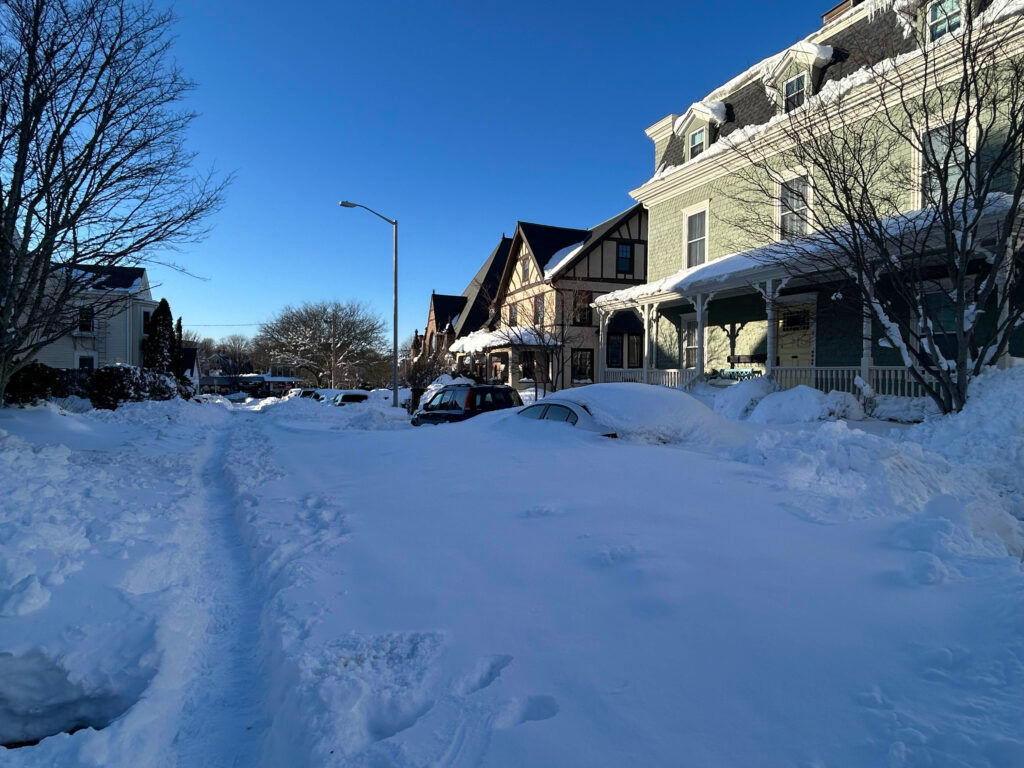
Members of Rhode Island’s congressional delegation are pressing the Trump administration to provide a full accounting of why the Federal Emergency Management Agency has repeatedly refused to approve major disaster assistance for the state following a destructive winter storm in February 2026.
In a formal letter sent on September 9, U.S. Senators Jack Reed and Sheldon Whitehouse, together with U.S. Representatives Seth Magaziner and Gabe Amo, called on FEMA and its parent agency, the Department of Homeland Security, to immediately preserve and disclose all internal communications and records concerning the state’s aid application.
The lawmakers expressed frustration that federal officials have continuously withheld a comprehensive written explanation for rejecting Rhode Island's disaster declaration. According to the delegation, the state had presented verifiable damages that clearly surpassed the established federal financial thresholds required for supplemental disaster relief.
The dispute stems from a severe weather emergency that paralyzed the region earlier in the year. Rhode Island Governor Dan McKee initially submitted a disaster relief request on April 7, seeking $19 million under the Stafford Disaster Relief and Emergency Assistance Act. The statute enables state executives to request federal intervention when severe weather inflicts damage beyond the operational and financial capabilities of state and municipal authorities.
Despite the documented expenses, FEMA formally rejected the state’s initial application on July 2. Governor McKee subsequently appealed the decision, but the agency reaffirmed its refusal in a secondary determination issued on September 2.
In both instances of denial, federal emergency administrators declined to supply specific criteria or detailed reasoning for turning down the request. Instead, FEMA’s formal correspondence relied on standard language asserting that, following a review of available information, supplemental assistance under the Stafford Act was not deemed warranted.
The repeated rejections drew sharp criticism from state leadership, with Governor McKee describing the federal agency’s September appeal denial as a new low for relations between the state and federal disaster management leadership.
The delegation maintained that the meteorological event warranted federal intervention due to its sheer scale and destructive force. When the storm struck on Monday, February 23, 2026, it deposited more than three feet of snow across several areas of Rhode Island.
Official measurements taken at Rhode Island T.F. Green International Airport recorded 37.9 inches of accumulation from the system. This total surpassed the state's long-standing historical benchmark established during the Blizzard of 1978, which had produced 28.6 inches of snowfall.
In addition to the historic snowfall totals, the blizzard generated severe winds, with recorded gusts reaching up to 74 mph. Lawmakers emphasized that these winds matched the intensity of a Category 2 hurricane, knocking out electrical power to thousands of residents and causing widespread infrastructure disruptions.
The combined impact of the wind and extreme snow resulted in an estimated $19 million in total cleanup expenses and physical damages statewide. The financial burden was split between state agencies, which absorbed approximately $9 million in costs, and local cities and towns, which incurred the remaining $10 million.
Following the September appeal rejections, FEMA Administrator Cameron Hamilton addressed the situation publicly on September 3 through a post on X. Hamilton stated that similar relief denials had been applied to appeals from New York, New Jersey, and Massachusetts, asserting that none of the affected northeastern states had supplied new information for review and remarking that winter weather is not an unfamiliar occurrence in the Northeast region.
Rhode Island’s congressional representatives firmly rejected that characterization, arguing that treating the February storm as ordinary seasonal weather dismisses the severe toll it took on local communities. In their letter, the delegates asserted that downplaying the event minimizes the hardships experienced by citizens and business owners who suffered significant disruption.
The lawmakers stressed that inspecting internal agency deliberations is necessary to ascertain whether the official rationale provided by Hamilton aligns with FEMA’s factual evaluations. The delegation warned that if federal officials fail to preserve and deliver the requested documentation, the public can reasonably conclude that the administration's justification lacks merit.
When questioned about the congressional inquiry, representatives from both FEMA and the Department of Homeland Security stood by Hamilton’s previous remarks, maintaining that the requesting states had failed to provide any new factual material to warrant reversing the disaster aid decisions.






(0)