
Sweeping new legislation introduced in Trenton aims to dramatically curtail the reach of automated license plate readers across New Jersey, proposing to ban private surveillance networks and force law enforcement agencies to purge the vast majority of vehicle travel records within 48 hours. The measure represents one of the most aggressive legislative efforts in the country to rein in artificial intelligence-powered camera systems.
The proposal, designated as Assembly Bill A5483, was formally introduced on September 14 by Assemblyman David Bailey Jr., a Democrat representing Salem County. The bill focuses directly on automated license plate recognition technology, widely referred to as ALPR. These systems, frequently operated under the commercial brand name Flock, utilize roadside cameras and artificial intelligence software to capture passing vehicles, recording their license plate numbers alongside details such as vehicle color, make, and model into centralized, searchable databases.
In announcing the legislation, Bailey underscored the urgent need to protect constitutional freedoms in an era of expanding technological surveillance. He expressed grave concerns that the widespread implementation of automated scanning tools threatens the privacy of Garden State residents by cataloging their regular daily routines. Bailey noted that allowing artificial intelligence networks to continuously log the movements of ordinary citizens creates unacceptable civil liberties risks, particularly when that information can be disseminated and retained indefinitely.
While acknowledging that technological surveillance can play a legitimate role in helping officers solve serious offenses, Bailey emphasized that law enforcement cannot be permitted to rely on unregulated artificial intelligence systems that monitor residents statewide without clear boundaries. The legislation, he stated, is designed to establish meaningful statutory oversight and robust safeguards, thereby achieving a workable balance between public safety needs and individual privacy rights.
Under the provisions of the measure, private citizens, neighborhood groups, and commercial businesses would be entirely prohibited from owning or running automated license plate readers, with exceptions made only for vendors responsible for selling and installing the hardware. Non-law enforcement entities currently utilizing such surveillance devices would be mandated to take them down and permanently delete all accumulated data files. To ensure compliance, the bill authorizes the New Jersey Attorney General to initiate legal action against noncompliant operators.
Government use of the technology would also face stringent new statutory guardrails compared to current practices. General state agencies would only be permitted to deploy scanning equipment for highly specific operational purposes, including managing vehicle parking facilities, monitoring access to secured locations, and administering electronic highway toll collection.
For the New Jersey State Police and local municipal departments, operational permissions would be strictly confined to predefined "be on the lookout" alerts, commonly known as BOLO lists. Under the proposed statutory standards, law enforcement queries and alerts would be limited exclusively to cases involving active missing person searches, stolen automobiles, serious criminal investigations, and specific regulatory matters such as uninsured, unregistered, or uninspected vehicles.
The bill further introduces explicit civil rights protections to ensure surveillance infrastructure is not abused. Police departments would be strictly prohibited from positioning or directing camera networks to target specific neighborhoods or populations based on protected characteristics, such as race, national origin, religious beliefs, or disability status.
Among the bill's most substantial revisions is a near-total overhaul of New Jersey's data retention standards. Current state policies permit law enforcement agencies to warehouse collected ALPR scanning data for up to three years. Bailey’s proposal would replace this window with a mandatory rule requiring the automatic and permanent deletion of scanned records within two days, unless specific files are formally preserved for active criminal investigations, authorized by court orders, or tied to flagged offenses such as stolen vehicles.
The proposed 48-hour retention window would represent a dramatic departure from New Jersey's status quo, which currently ranks among the most extensive data-storage periods nationwide. Investigative reporting by NJ.com has highlighted that the majority of states maintain license plate records for 30 days or less, with some jurisdictions requiring non-matching vehicle scans to be deleted in as little as five minutes after capture.
The legislation also establishes tight controls regarding who can access vehicle tracking information. Under A5483, sharing New Jersey's camera records with federal law enforcement or out-of-state authorities would require a formal search warrant approved directly by the state Attorney General. This requirement would significantly alter existing practices, as State Police officials have acknowledged that vehicle scan repositories are presently accessible to selected regional partner agencies in neighboring states and certain federal law enforcement entities based in New Jersey.
Commercial vendors that manufacture and service the scanning infrastructure would also be subject to tight constraints. The legislation strictly forbids third-party contractors from selling, licensing, or sharing collected data. Furthermore, all public agencies operating ALPR networks would be subjected to mandatory annual compliance audits and public reporting mandates to guarantee transparency.
The introduction of Bailey's bill comes after months of mounting statewide debate surrounding the ubiquity of automated camera systems. Public audit records reveal that 523 out of approximately 530 police departments across New Jersey utilize some form of license plate recognition technology. Furthermore, company records show that at least 82 local agencies spanning all 21 counties have contracted directly with Flock Safety to operate their camera networks.
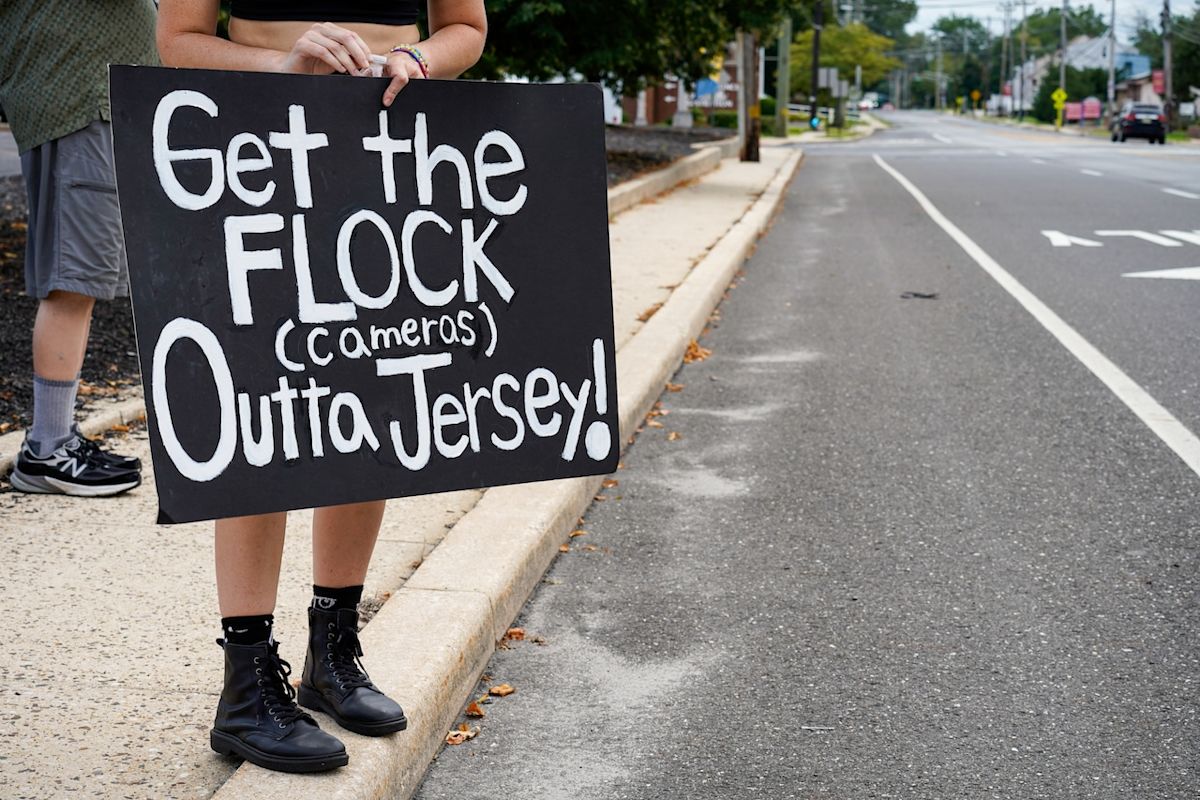
The rapid proliferation of these cameras has sparked visible public pushback across several communities. In August, grassroots activists organized by the advocacy group DeFlock South Jersey demonstrated outside a Home Depot store in Berlin Township, accompanied by a mascot named "Flocky," to demand an immediate halt to camera installations until comprehensive state regulations are enacted. Similar public concern surfaced in Franklin Township, where a heavily attended municipal council meeting saw residents protest local camera programs, backed by a petition that amassed more than 800 signatures.
Bailey’s proposal joins several other legislative initiatives in Trenton aimed at regulating digital vehicle tracking. State Senator Benjie Wimberly, a Passaic County Democrat, previously introduced legislation to lower retention limits to two years and establish criminal penalties for unauthorized data use, while Democratic State Senator Linda Greenstein of Middlesex County has sought to ban the transfer of camera logs to out-of-state entities investigating reproductive healthcare procedures. Additionally, Republican State Senator Michael Testa of Cumberland County outlined plans over the summer to present his own oversight framework.





(0)