
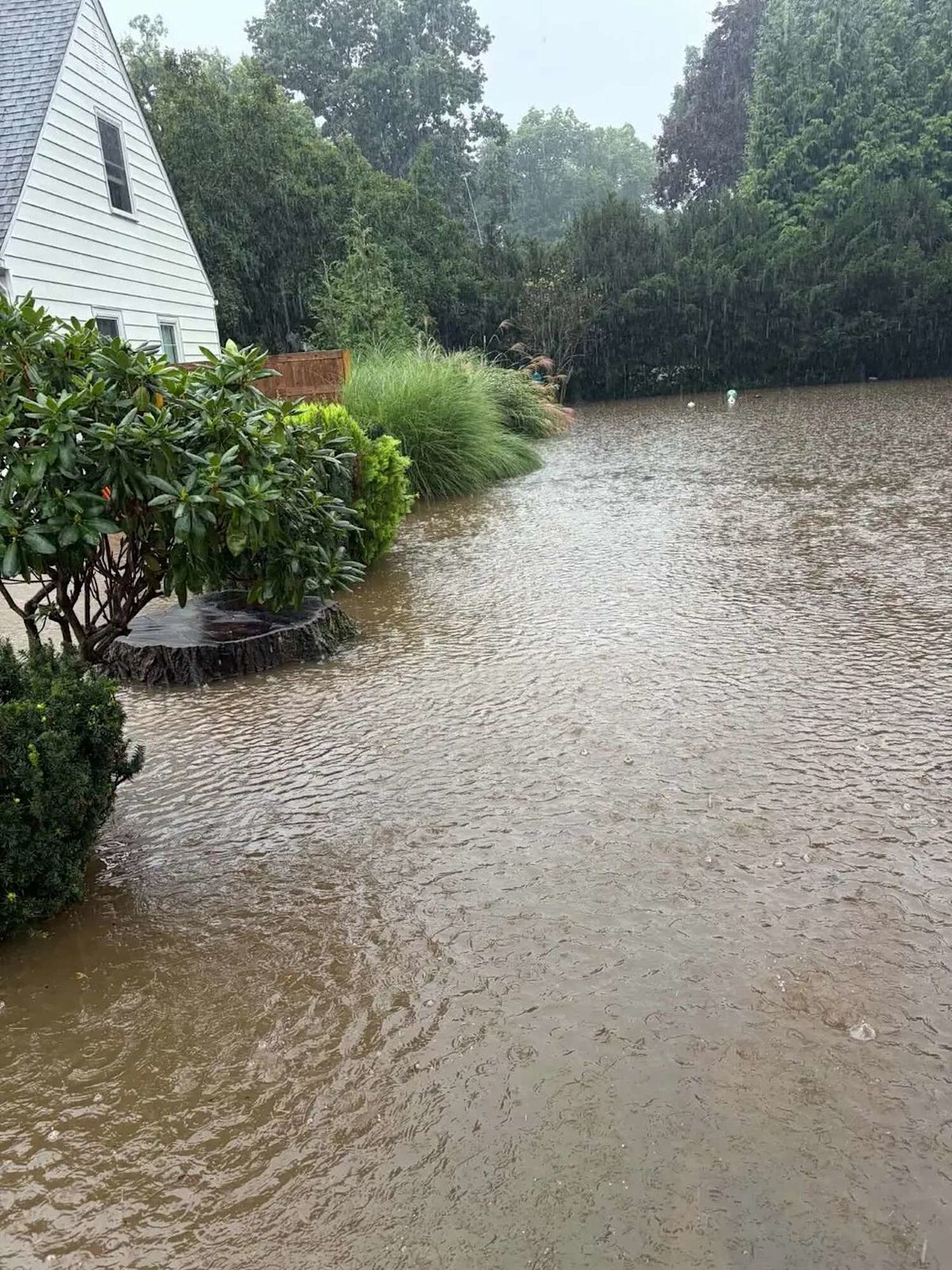
Fairfield residents living along the Rooster River are grappling with the aftermath of another destructive deluge, as local homeowners face catastrophic basement inundations and voice frustration over prolonged municipal delays in flood control infrastructure. Among those hardest hit is George Paci, who watched roughly seven feet of water swallow his basement following a weekend storm, just months after dealing with prior flood damage.
According to Paci, the floodwaters surged at an alarming speed once the Rooster River spilled over its banks. Within roughly 20 minutes of entering the residence, water rushed into the basement until it reached all the way to the first-floor joists. Outside, his yard was submerged beneath two feet of water, while his detached garage suffered extensive damage from incoming water and mud.
The weekend disaster marked the fourth major flood Paci and his wife have endured over an eight-year span. The chronic water intrusion has resulted in recurring financial losses and endless repairs. Over that period, Paci has had to replace his furnace three times, his clothes dryer four times, his washing machine three times, and his home’s electrical service panel three times. In addition, expensive power tools are currently corroding in the dampness, with their usability still uncertain.
During the height of the storm, Paci deployed his basement sump pump along with two supplementary pumps in an effort to protect his property. However, the pumping efforts proved ineffective, as the discharged water was merely redirected onto an already saturated yard that could absorb no more moisture. With power knocked out and additional precipitation lingering in the forecast, Paci’s flood-damaged possessions remain piled outside across his lawn.
For Paci and his neighbors, the emotional and economic strain is compounded by a deep sense of entrapment. Because prospective homebuyers are unlikely to purchase properties that regularly suffer devastating inundations, selling the house is not a realistic exit strategy. As a result, residents describe feeling stranded and increasingly exhausted after waiting nearly a decade for local government initiatives to materialize into actual protection.
Fairfield First Selectperson Christine Vitale acknowledged the unusual ferocity of the weather event, pointing out that more than six inches of rain fell across the community in an exceptionally compressed window of time. She noted that the sheer volume of precipitation overwhelmed areas that typically do not suffer from basement flooding, adding that municipal officials are actively collecting data to assess the full scale of the destruction.
The torrential downpours also triggered widespread electrical outages across Connecticut, complicating cleanup operations for numerous households. Paci is among those who have had to haul drenched belongings and clear out mud without working electricity, facing the arduous recovery process under difficult physical conditions.
In response to mounting community criticism, Fairfield Public Works Director Frank Petise explained that mitigation along the Rooster River watershed has been an active municipal priority for roughly eight to 10 years. He emphasized that the protracted timeline stems in large part from complex regulatory requirements, specifically the time needed to secure environmental and engineering permits from the Connecticut Department of Energy and Environmental Protection and the U.S. Army Corps of Engineers.
Initial planning for the watershed project began using existing municipal resources in the wake of significant flooding in 2018. Over the intervening years, the town has assembled an $8.2 million funding package dedicated to comprehensive flood reduction measures. This financial pool combines $4.5 million in local municipal bonds, $2.5 million in state appropriations, a $280,000 grant from DEEP, and $750,000 in federal American Rescue Plan Act funds provided by the city of Bridgeport, which owns property within the watershed.
Petise noted that tangible construction is finally poised to commence. Two major detention basin projects—one situated at Fairchild Wheeler Golf Course and another located in Tunxis Hill Park—were put out to bid during the summer months. Work on both of these installations is scheduled to get underway before the conclusion of the current month.
In addition to the two initial basins, engineering teams are designing a third detention basin, a project that requires ongoing coordination and easement negotiations with private property owners. The broader $8.2 million plan also incorporates dredging along designated stretches of the Rooster River. According to Petise, if all proposed initiatives are fully realized, the cumulative improvements are projected to decrease regional flooding by 30 percent or more.
Petise placed the recent disaster within the context of changing meteorological patterns, characterizing the weekend deluge as the equivalent of a 100-year storm event—a statistical benchmark meaning a rainfall of such magnitude carries only a 1 percent probability of happening in any single year. He observed that severe weather events are demonstrating a noticeable increase in frequency.
Despite the town’s assurances regarding upcoming construction and future flood reduction statistics, residents remain wary. Paci remarked that many neighbors have lost faith that the proposed engineering projects will provide adequate protection, expressing deep skepticism after years of hearing about potential fixes while continuing to bail out their homes.
The storm also sparked discussions among community members regarding emergency communications, with some residents reporting they did not receive municipal flash flood warnings on their cell phones. Addressing these concerns, Vitale clarified that the town opted to rely on the National Weather Service's automatic mobile alert network, which transmits notifications to every device within an affected geographic zone without requiring sign-ups, while local officials directed their own efforts toward sharing Fairfield-specific updates via social media channels.







(0)