
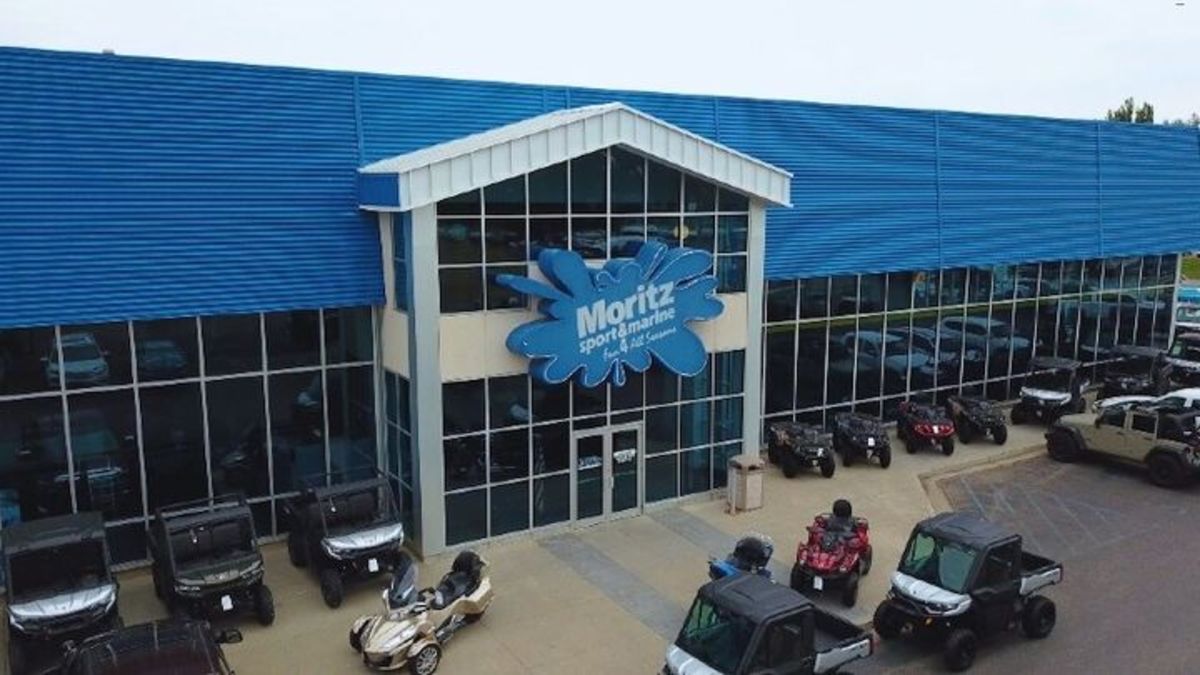
Applying traditional automotive dealership principles to powersports retail has proven to be a lucrative strategy for Eric Moritz. At Moritz Sport & Marine in Bismarck, North Dakota, adopting the operational discipline of car sales has transformed the business into a high-volume enterprise. Today, the dealership sells approximately 300 new side-by-side utility vehicles annually, generating around $10 million in revenue from that single category alone.
This new-unit volume represents only part of the facility’s total sales footprint. Alongside its strong new inventory movement, the Bismarck dealership also cycles through 200 to 300 pre-owned all-terrain vehicles (ATVs) and utility terrain vehicles (UTVs) each year, maintaining a steady pipeline of traded and resale machines.
The foundation for this sales approach is rooted in the Moritz family's long history in car retailing. Nearly three decades ago, Moritz and his father transitioned away from the traditional auto sector to acquire a local Chevrolet dealership in Bismarck. In 1997, they converted that automotive property into Moritz Sport & Marine, establishing a powersports hub built upon the fundamentals they mastered on the showroom floor.
That automotive orientation was further cemented during a major ownership transition in 2020. When Moritz's father retired, equity in the business was acquired by friends who operated auto dealerships in the region. This influx of automotive retail leadership reinforced the company's commitment to operating the powersports store with the procedural rigor typically found in mainstream car dealerships.
Moritz has observed that the powersports retail sector generally trails the automobile industry by approximately five years. While this gap is partly visible in technological advancements, he emphasizes that the discrepancy is most noticeable in day-to-day business management, workflow structures, and overall operational execution.
To bridge that divide, Moritz Sport & Marine implemented a full-service sales desk modeled directly on modern car buying procedures. Under this system, a prospective buyer interacts with an integrated team comprising the sales manager, finance representatives, service personnel, and accessories specialists in a single, coordinated consultation.
The primary goal of this comprehensive sales framework is to streamline the buying process while maximizing vehicle customization. By introducing accessories and service plans during the initial transaction, the dealership ensures customers drive away with a fully equipped machine tailored to their needs, establishing an ongoing service relationship from day one.
The store's sales momentum accelerated dramatically with the introduction of modern utility platforms, particularly the Can-Am Defender. Before the Defender debuted roughly a decade ago, the dealership moved only 10 to 15 new units annually. Today, the Defender—especially its enclosed full-cab configurations—has become the store's primary revenue driver outside of its marine offerings.
To keep pace with the dramatic increase in machine volume and customer support needs, the dealership significantly scaled up its technical operations. In recent years, Moritz Sport & Marine doubled its dedicated Can-Am service staff, expanding the team to 12 specialized technicians to handle maintenance, setup, and custom installations.
Consumer preference has shifted heavily toward climate-controlled, enclosed-cab side-by-sides that offer an experience comparable to driving a pickup truck. Equipped with factory heating and air conditioning, these machines provide year-round comfort, making them appealing to buyers seeking functional everyday transportation rather than purely recreational toys.
Local traffic regulations in North Dakota have further accelerated this trend toward practical road use. State law permits off-highway vehicles on paved roads outside of major highways, and machines can be driven statewide once outfitted with basic street-legal packages, including turn signals, mirrors, a horn, and an official license plate.
Despite the strong market appetite, rising equipment costs present an ongoing challenge for the industry. Highly optioned side-by-sides outfitted with premium accessories and full enclosures are now approaching prices near $50,000, raising concerns about long-term affordability for mainstream consumers.
At the same time, the dealership is taking a cautious stance on emerging technology within the powersports sector. Although manufacturers have begun entering the electric space—highlighted by the summer rollout of the Can-Am Outlander Electric—Moritz remains hesitant to commit heavily to battery-powered inventory at this stage.
Several operational and practical hurdles contribute to this wait-and-see approach regarding electric off-road vehicles. Moritz points to limited battery range and the current lack of widespread charging infrastructure as major barriers for consumers, alongside the substantial capital investments required for specialized dealer tooling and technician certifications.
By combining the customer-retention strategies of the automotive industry with a focus on fully outfitted utility machines, Moritz Sport & Marine continues to build a high-volume retail engine in the Upper Midwest.





(0)