
Political satire and sharp caricatures have been woven into the fabric of American campaigns since the founding era, when printed sketches skewered political figures. In those early decades, hand-drawn editorial cartoons made no pretense of capturing literal reality, leaving little doubt among voters about what was authentic and what was illustrative parody. Today, modern technology has radically altered that dynamic as the 2026 midterm campaign moves into its final seven weeks, bringing sophisticated digital fabrications directly to the forefront of state politics.
The rapid rise of artificial intelligence has made the generation of synthetic media remarkably simple and inexpensive. Anyone possessing modest computer skills and basic source imagery can now produce hyper-realistic video clips in a matter of minutes. Known across political and technology circles as deepfakes, these altered clips present entirely fabricated events with photographic plausibility, presenting unprecedented challenges for voters attempting to separate genuine candidate appearances from digital fabrications.
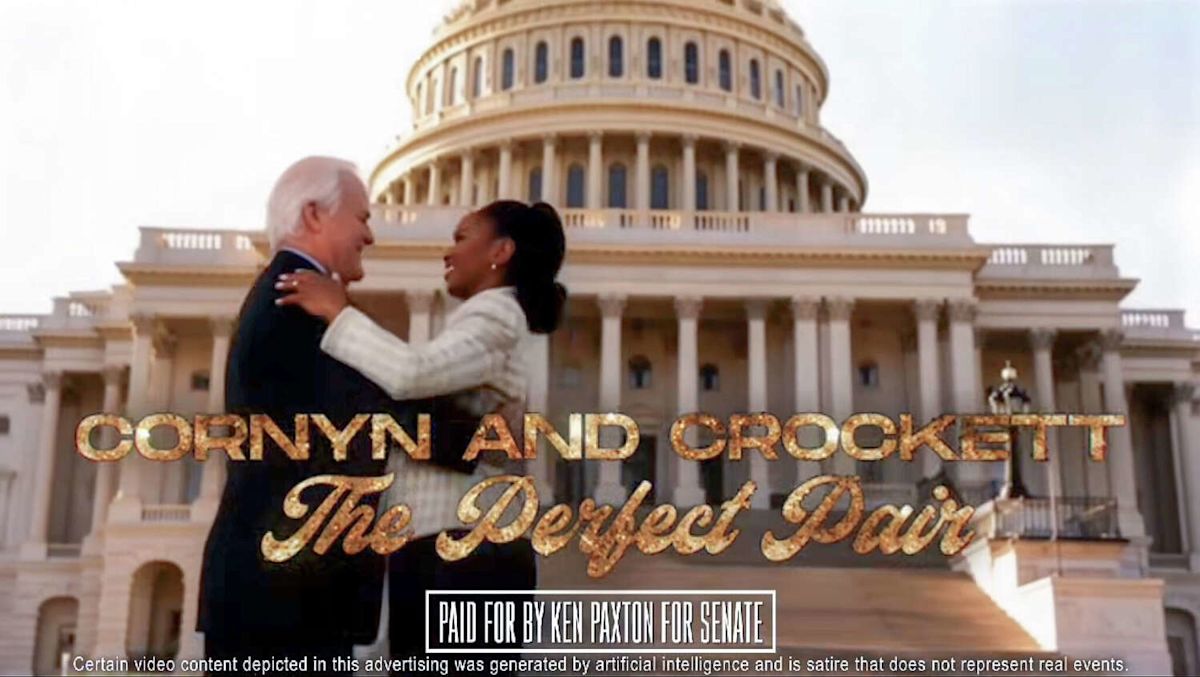
The practical impact of this technology was on full display during the contentious Republican primary contest for the United States Senate in Texas. Throughout the primary and subsequent runoff campaign, Texas Attorney General Ken Paxton utilized an AI-generated video targeting veteran incumbent Sen. John Cornyn. The digital creation portrayed Cornyn smiling while dancing cheek-to-cheek with Democratic U.S. Rep. Jasmine Crockett, who was then running in the Democratic Senate primary.
To heighten the ad's persuasive effect, the campaign spliced the artificial dancing sequence alongside genuine archival video of Crockett. In the authentic footage, the congresswoman referenced instances where she and Cornyn had previously worked together across the aisle to advance bipartisan legislation. The blended presentation was designed to undermine Cornyn’s standing among conservative primary voters by exaggerating his ties to high-profile Democrats.
Cornyn quickly responded to the visual attack with a sophisticated deepfake ad of his own. His campaign’s counter-ad placed an animated version of Paxton behind the wheel of a 1960s-era convertible, cruising along while an audio track played a cover band’s rendition of the popular B-52s song "Love Shack." The production was styled to mock the attorney general while drawing direct attention to his personal background.
The explicit goal of Cornyn's synthetic commercial was to remind the Republican electorate of the extramarital affairs Paxton had been accused of engaging in. Those allegations had previously led Paxton's wife to initiate divorce proceedings against him. By weaponizing AI imagery, the Cornyn campaign sought to highlight the attorney general’s personal controversies during a critical window of the nominating contest.
Whether these dueling digital fabrications exerted a decisive influence on the ballot box remains difficult to measure. Paxton unveiled his AI advertisement in the weeks preceding the March primary election, where Cornyn secured a plurality of the vote but fell short of the threshold needed to prevent a runoff. When the candidates faced off head-to-head in the runoff, Paxton secured the Republican nomination in a landslide victory.
Following his primary triumph, Paxton continued to deploy AI-generated media against his general election challenger, Democratic candidate James Talarico. Talarico had successfully secured the Democratic nomination after defeating Crockett without requiring a runoff election. As a seminarian who openly discusses his religious faith on the campaign trail, Talarico has frequently drawn criticism from Christian conservatives who argue his liberal theological views clash with traditional values.
Paxton’s latest synthetic campaign ad directly takes aim at Talarico’s religious and social views. The video depicts an AI rendering of Talarico physically altering biblical passages, claiming that scripture supports the idea of six biological sexes and portraying Jesus Christ as a radical feminist. The digitally produced version of the candidate appears and speaks like someone roughly twenty years younger than the 37-year-old Democratic nominee.
The ad seizes upon previous public remarks by Talarico regarding biological sex and gender identity. Talarico had previously stepped back from his earlier statements concerning the concept of six biological sexes, explaining that he had spoken clumsily while attempting to convey a broader point during a past discussion. Nevertheless, the Paxton ad utilized synthetic tools to visually amplify the controversy for the general election audience.
The expanding use of deceptive imagery in modern campaigning raises complex legal and constitutional questions. Early political parodies enjoyed broad First Amendment protections for speech, religion, and the press, even when targeting foundational figures and documents. In modern electoral politics, lawmakers have sought to delineate where free expression ends and deliberate voter deception begins.
Texas lawmakers previously attempted to curb malicious synthetic media by passing a statute in 2019 that outlawed the distribution of deceptive deepfakes within 30 days of an election. However, the state prohibition does not extend to federal campaigns, leaving federal offices like the U.S. Senate race outside the immediate scope of the state's restrictions.
State Sen. Bryan Hughes, the Mineola Republican who authored the 2019 legislation, explained that the policy was designed to protect the integrity of elections while respecting core First Amendment guarantees. Yet as federal candidates freely harness artificial intelligence in their bids for office, the line between protected political speech and digital voter deception continues to blur.








(0)